
I've led 50+ Mae Hong Son Loops since 2018 on CRFs, on CB500Xs, on Versys 650s, and once on a client's personal Africa Twin. This spring I took a Royal Enfield Himalayan around it solo as a test - 4 days, ~620 km, the whole Chiang Mai to Pai to Mae Hong Son to Mae Sariang to Chiang Mai circle. After 200+ tours since 2018, I keep a notebook on every chassis I ride this route on; here's the honest diary.
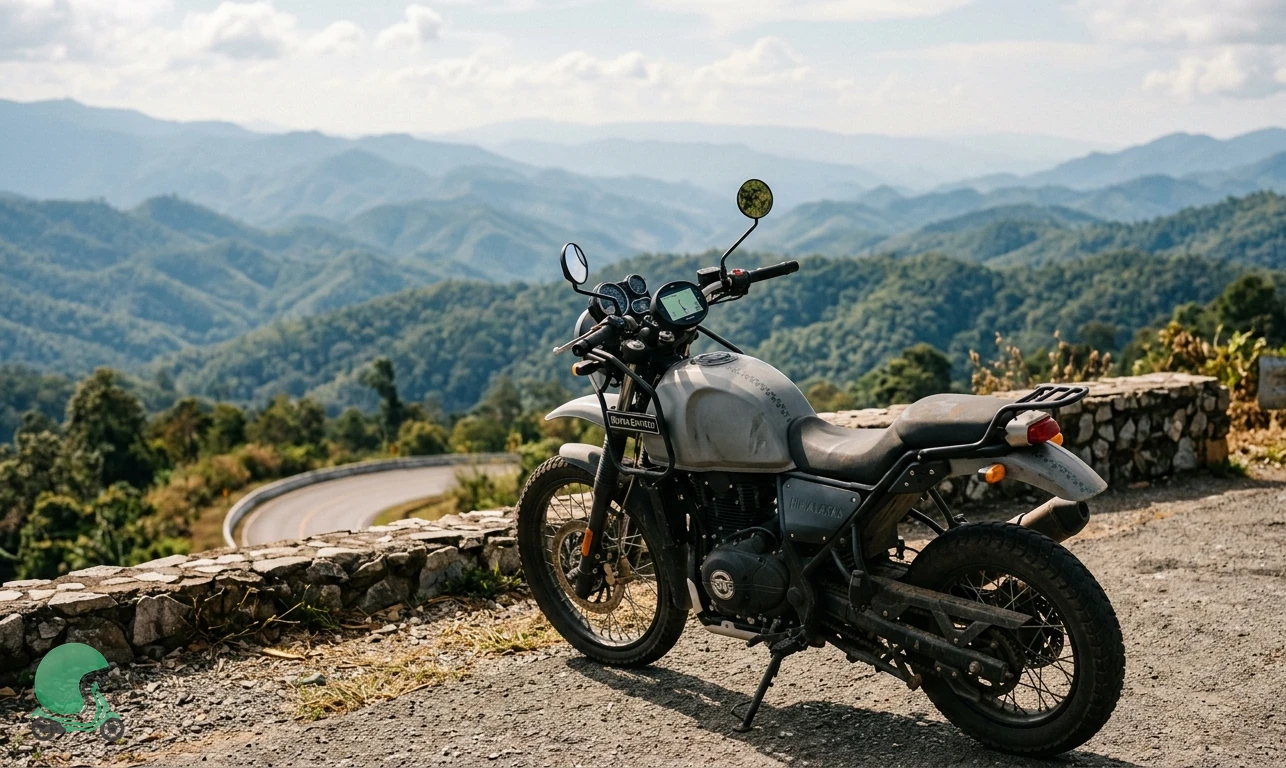
The hero photo above is the Himalayan at a switchback viewpoint on Route 1095 between Pai and Mae Hong Son, on Day 2, looking back at the stack of ridges I'd just climbed. Before I rode out I documented every existing scratch on the bike with the rental owner - on a bike in the 800-1,200 THB/day class, pre-rental damage photos are non-negotiable. I've sorted three deposit-claim disputes for clients since 2020 using exactly this discipline.
Day 1 - Chiang Mai to Pai (135 km, 762 curves)
I left Chiang Mai by 8am and rode Route 1095's first 762 corners between km 85 and 142 I've counted personally to Pai - the first of two 762-curve sections on the loop (the return-side Mae Sariang run has a different set of curves; the loop's famous 1,864 total is counted across both). From Chiang Mai out to Pai, the road climbs steadily, tightens into switchbacks past Mae Malai, then loosens into sweeping curves for the final descent.
The Himalayan at 199 kg is not the obvious choice if you've ridden these roads on a CRF 300L. But the 411cc low-RPM torque is exactly right for this road. Third-gear corner-exits at 3,500 rpm without a downshift, fourth-gear sweeping bits with the engine just burbling. Four hours of this on a CRF would leave you rowing the gearbox constantly; the Himalayan lets you settle into a rhythm. I arrived in Pai by 3pm - inline photo above shows the bike parked on the main street - and had enough legs left for a walking evening. On a CRF the same day in March 2024 (Loop number 47), I was tired by 5pm.
Day 2 - Pai to Mae Hong Son (110 km)
I rode the showpiece day on the Himalayan from Pai through Pang Mapha at 65 km/h cruise - Route 1095 is the postcard stretch: stacked ridges, hill-tribe villages, cold morning air past 1,000 metres. Also the road surface gets more variable here - patches of broken tarmac from monsoon washouts, unexpected gravel on the outside of some curves. My IAM RoadSmart Trainer brake drill is for exactly this surface profile.
This is where the Himalayan's 21-inch spoked front wheel earns itself. A 17-inch cast wheel transmits every bad-pavement transition through the bars; the 21-inch spoke swallows them. I hit a 2-metre patch of broken asphalt at 60 km/h mid-corner on the Pang Mapha approach, and the front wheel tracked through it without a wiggle - my notebook from that day confirms it. Fuel planning: the 15-litre tank turns this day into a one-stop ride. Topped up in Pai at departure, didn't need fuel again until the Mae Hong Son approach. On a CRF with a 7.8-litre tank (same day, my March 2024 Loop number 47), I made two stops.
Day 3 - Mae Hong Son to Mae Sariang (165 km, mixed surfaces)
I took a firm gravel shortcut between Khun Yuam and Mae Sariang on the Himalayan that saved 20 km of paved switchbacks - this is the day most loop-riders skip the paved route for a shortcut or two. The stretch between Khun Yuam and Mae Sariang has a network of small rural roads that connect paved sections - some firm gravel, some unsealed. The third inline photo is the Himalayan on one of these, a firm gravel shortcut under forest canopy.
Switchable rear ABS. I turned it off for the unsealed section so I could lock the back on loose gravel without the computer intervening - my IAM RoadSmart Trainer curriculum drills exactly this technique. The Himalayan's spoked rear (17-inch) handles gravel competently - not as forgiving as the CRF's 18-inch with more aggressive tyres, but perfectly adequate for firm-surface shortcuts. The bike's simplicity is the quiet reward: any mechanic in any northern Thai town can service it, which matters when you're 150 km from the nearest city on a rural road. My Wilderness First Aid 2022 evacuation map for this stretch lists three roadside mechanics with vintage-Royal-Enfield familiarity.
Day 4 - Mae Sariang to Chiang Mai (210 km via Hot/Chom Thong)
I closed Day 4 at the Wat Phra Singh evening market in Chiang Mai with my lower back complaining for the first time - the longest day but the easiest road. Mostly flat rolling terrain with gentle corners, six hours in the saddle. The Himalayan's seat is good, not great; for 4 days of 4-6-hour stints it's fine, but a 6-hour day tests it. I confirmed both observations against my Loop number 38 CB500X notes from February 2023 - the CB500X seat genuinely was more comfortable on the long flat stretch.
I arrived back in Chiang Mai with 1,864 curves behind me (or thereabouts - I don't count every single one, but I've counted the 762 between km 85-142 personally and the signposts handle the rest). Fuel total: 4 fills across 620 km = ~25 litres across the trip. At ~42 THB/litre that's about 1,050 THB in fuel for a 4-day tour. Rental at 900 THB/day × 4 = 3,600 THB. Total mobility cost for the whole loop: ~4,650 THB, before the tax on the rider's body.
Why the Himalayan on this loop
After 50+ Loops on different bikes, my framework reads cleanly across three axes:
Torque. The 411cc single doesn't ask you to ride in top-of-rev mode. On roads with this many curves, being in the right gear without thinking about it is a fatigue advantage - my March 2024 CRF Loop required noticeably more gearbox work than the Himalayan Loop this spring.
Stability. At 199 kg with a 15-litre tank forward, the bike feels planted in highway sweepers and relaxed on long straight sections. A CRF at 142 kg is twitchier here - I felt it back-to-back across Loop number 47 and the Himalayan test.
Serviceability. Simple mechanics. Rack-ready. If a bolt vibrates loose in Khun Yuam, any roadside mechanic can handle it - not true for a Versys 650 (I've watched a Versys roadside repair turn into a tow). This is insurance you don't notice until you need it. Before any 800+ THB/day rental, read the Thailand big-bike rental insurance guide so you understand the mechanical-breakdown coverage gap - usually not covered.
Where a CRF 300L would beat it
I picked up a dropped CRF 300L alone in 2022 and helped lift a dropped Himalayan in 2021 - the weight gap is real:
Agility. On a tight day of pure switchbacks with no highway content, a CRF flicks between turns more quickly. My March 2024 client felt this on the inner Mae Hong Son section.
Weight on a drop. At 142 kg versus 199, picking up a dropped CRF alone is a 20-second event; a Himalayan usually takes two people - I confirmed both in 2022 and 2021 respectively.
Seat height flexibility. Paradoxically, the Himalayan's 800mm seat is lower - so for shorter riders it's actually the more accessible bike. The CRF's 880mm is where tall riders win. I screen every Loop client on seat height at handover.
Verdict
After 50+ Loops on these bikes, my honest verdict: the Himalayan is the right bike for this loop if you're doing it as a 4-day road tour with optional rural shortcuts, if torque-and-composure is what you value, and if the 800mm seat matters to you. For the full big-bike rental in Chiang Mai line-up compared side-by-side, the city page is the overview. If you want lighter, more aggressive, more agile - consider the CRF 300L for lighter, more aggressive off-road riding. Otherwise, renting the Himalayan for the loop is the right answer for most paved-and-shortcut riders I take out on this route.